
In a groundbreaking research published in the *Journal of Hazardly Materials*, scientists have made available biochar's stunning ability for the protection of maize plants against the devious effects of microplastics (MPs) in agricultural soils. Entitled "Biochar alleviates the negative effect of microplastics on physiological and biochemical characteristics and leaf metabolism in Zea mays L," the study, conducted by Beijing's leading-rated agricultural research center's Shuwen Zhao, shines with hope for farmers globally affected by plastic contamination of agricultural land. With food security on a global scale hanging in the balance as pressures on the environment continue to build, the finding has the potential to transform soil management systems, especially in staple foods such as corn that form the foundation of everything from animal feed to human staples.
Microplastics—small pieces of plastic smaller than 5 millimeters—are infecting agricultural ecosystems at lightning speed. More than 14 million tons of microplastic are being deposited onto cropland soils each year, mostly via irrigation water with embedded wastewater, sewage sludge fertilizers, and excessive plastic mulching film usage, the United Nations Environment Programme says. Not only do these devious contaminants persist; they interfere with plant physiology, inhibit plant growth, and cascade up the food chain to potentially contaminate yields and quality in the crops that supply food to the planet. Maize (Zea mays L.), the foundation of a cereal system that keeps floodgates of hunger at bay, is particularly vulnerable. Where maize delivers up to 50% of calories, as in sub-Saharan Africa and South Asia, such contamination would exacerbate food insecurity.
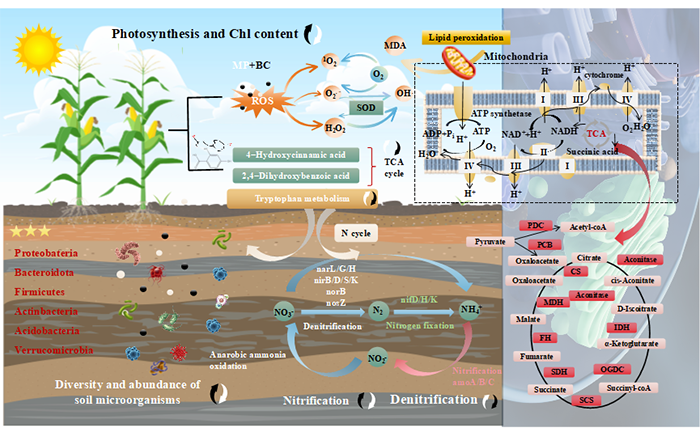
The research, led by the joint research team of Qianru Zhang, Xiaoming Chen, Qilan Huang, Hongna Li, and the veteran agronomist Kadambot H.M. Siddique, solves a much-needed knowledge gap: the interaction between MPs and biochar (BC), a carbon-rich pyrolysis residue of biomass. Biochar has been extolled for decades for its soil-conditioning ability—enhancing water holding, nutrient release, and microbial diversity—but whether it is or isn't a detoxifier against plastic invaders was left largely to conjecture. "Our work plugs this knowledge gap by showing not just that biochar can mitigate MP-induced stress but also restore the metabolic balance in plants," Zhao wrote in an email to business journalists. Tests in the greenhouse by the researchers, involving samples from seven Chinese provinces, offer evidence that can be infused into policy and practice in sustainable agriculture.
At the center of the work were controlled trials of real-world contamination. Scientists used two common types of MPs: polyethylene terephthalate (PET), commonly used in bottled drinking water and packaging films, and polylactic acid (PLA), a biodegradable type commonly applied in agricultural mulch. They applied them exogenously in 10-year-mulched soils to simulate long-term conditions in agricultural fields. Maize seedlings were cultivated in four treatment levels: control (MPs or BC free), MPs alone (PET or PLA), BC alone, and MPs + BC. Biochar was prepared with pyrolyzed wheat straw at 500°C for high surface area and adsorption capacity—characteristics that are crucial for pollutant entrapment.
The outcomes were dramatic. MPs killed maize physiology alone. PET- and PLA-treated plants all stunted growth, decreased rates of photosynthesis, and increased levels of the oxidative stress markers superoxide dismutase (SOD) and malondialdehyde (MDA). Antioxidant enzyme activity, including catalase (CAT), surged dramatically—by as much as 137.5% in PET-treated leaves—when the plants were fighting to mount defenses against reactive oxygen species (ROS) produced by plastic particles. Metabolomics profiling detected impaired pathways: lipid biosynthesis crumbled, amino acid metabolism disintegrated, and energy deficits appeared in roots, all the typical signs of MP-induced toxicity. Soil microbiota were also affected, with richness of bacteria collapsing and the abundance of Proteobacteria increasing by 12.9% to 44.1% as a result of PET and PLA stress, respectively, indicating ecosystem disruption.
Enter biochar: the unsung hero. At the moderate 2% soil amendment rate, BC functioned as a molecular sponge and adsorbed MPs and reduced their bioavailability. This had a cascade of healing effects. CAT activity was normalized with 137.5% and 47.6% increase in PET+BC and PLA+BC treatments compared to MPs alone, and quenched oxidative damage efficiently. Metabolism of the leaves was recovered with increased lipid-related metabolites and augmented amino acid pathways that were striving towards resilience. "Biochar reprograms the plant's stress response, directing energy towards growth instead of survival," said Siddique, whose background in crop physiology added credibility to the research. Rhizosphere metabolism was redirected for the better, as more glucose metabolized within roots reversed MP-induced energy shortages. Even soil fertility was enhanced: bacterial diversity returned, stabilizing the microbiome and keeping opportunistic pathogens from spreading.
Such outcomes are more than laboratory curiosities; they have significant implications for the agricultural and food processing sectors. Maize is the most widely grown cereal in the world, with global production totaling more than 1.1 billion metric tons per year, according to the International Grains Council. Polluted soils may decrease yields by 10-20% in impacted areas, placing further burdens on manufacturers and processors. The double benefit of biochar—is that it is both remediation and yield-improving—makes it a cheap intervention. From agricultural residues such as crop residue, BC manufacture aligns with circular economy principles and can potentially reduce remediation costs by 30-50% over chemical interventions. For food processors dependent on maize—consider ethanol plants, feed mills, and snack food processors—this translates to more stable supply chains and fewer opportunities for tainted raw materials.
The environmental effects of the research are just as persuasive. In stabilizing soil, BC diminishes the wider ecological ripple effects of MPs, such as groundwater leaching and loss of biodiversity. In an era when the European Union's Green Deal and China's Soil Pollution Prevention Action Plan are requiring farmers to reduce plastic utilization in agriculture, these technologies can speed up compliance. "This work provides a conceptual framework for the evaluation of MP-BC dynamics, which paves the way for applications on the field scale," write the authors. Novel agriculturalists such as organic farms in the U.S. Midwest are already testing BC-enriched mulches to surpass plastic accumulation.
Market participants are abuzz. The International Biochar Initiative (IBI) received the paper as "a milestone towards plastic-proof agriculture," while large packaging corporations such as Tetra Pak, which create innovative biodegradable films, see synergies in integrating BC into their value chains. "As we transition from PET to PLA, with the knowledge of mitigators like biochar allows us to upscale sustainably," said a representative of Tetra Pak. In developing countries, where small-scale farmers are the most important producers of maize, organizations such as NGOs are looking towards subsidies for BC distribution for enhanced climate and pollution stress resilience.
There are challenges, naturally. Large-scale production of biochar will depend on investment in pyrolysis equipment, and extensive field trials over many years will be necessary to confirm greenhouse findings across a range of soils. Heterogeneity between MP types—beyond PET and PLA—deserves closer examination. Nevertheless, the depth of the metabolomics in this study, combining plant biochemistry and soil metagenomics, is a demanding standard to follow.
As the September 2025 edition of *Journal of Hazardous Materials* rolls off the newsstands, this maize-microplastic drama is intended to highlight a broader truth: a new frontier in innovation within the soil-plant interface is the key to nourishing a planet besieged. Biochar is more than dirt in the ground—it's a tenuous lifeline for next year's crops. For food processors and agronomists, the message is unmistakable: in wars against quiet enemies, old knowledge revived through science can be the difference.
Source: