
China, the world's fourth-largest potato producer, has long struggled with inefficiencies in the potato harvesting stage. Traditional manual or semi-mechanized digging and laying methods account for up to 45% of total labor in the production process, resulting in high costs, low efficiency, and intense physical demands. This challenge is especially acute in diverse terrains: complex hilly and mountainous regions versus vast plains, where plot variations and soil conditions make standardized machinery hard to adapt, severely limiting mechanization rates and industry scaling.
In a major advancement announced recently, the Green Farming and Root Crop Harvesting Technology and Equipment Innovation Team at the Nanjing Institute of Agricultural Mechanization (under China's Ministry of Agriculture and Rural Affairs) — supported by the Chinese Academy of Agricultural Sciences (CAAS) Science and Technology Innovation Project — has developed a full-scenario adaptable potato combined harvesting system after years of dedicated research. This series of equipment addresses the long-standing "bottleneck" in potato harvesting mechanization, delivering intelligent, efficient, and low-damage solutions to accelerate the modernization of the potato industry.
Focusing on industry pain points, the team systematically overcame key core technologies, including:
- Contour-following depth-limiting excavation for precise adaptation to uneven terrain without excessive damage.
- Low-damage, wear-resistant digging and floating anti-entanglement cutting to minimize tuber bruising and prevent weed or vine wrapping.
- High-efficiency, low-loss potato-soil separation for cleaner output and reduced mechanical injury.
Building on these breakthroughs, the researchers shattered the limitation of "one machine fits few places" by developing four specialized potato combine harvesters tailored to different regions and uses:
- Self-propelled powder-type for hilly mountainous areas — Ideal for starch-processing varieties in complex terrain.
- Self-propelled fresh-food-type for hilly mountainous areas — Optimized for table potatoes with high maneuverability.
- Traction-type powder-type for plains — High-capacity for large flat fields and starch varieties.
- Traction-type fresh-food-type for plains — Efficient for fresh-market potatoes on open land.
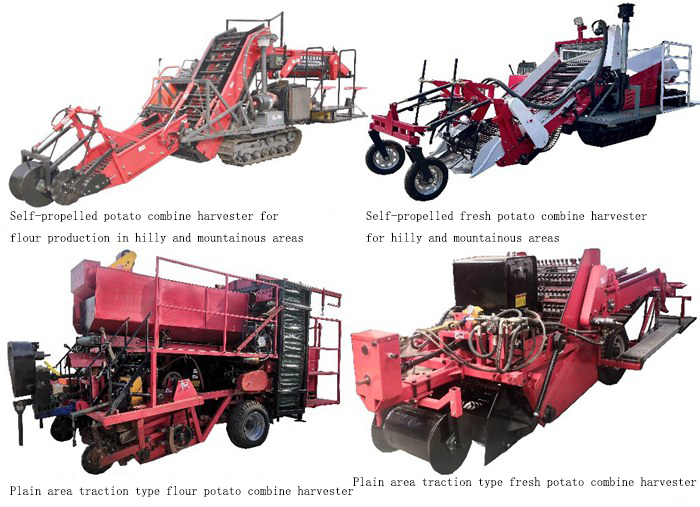
All four models perform a complete one-pass operation: depth-limited digging, potato-soil separation, stem separation, conveying and cleaning, collection, and intelligent control. By swapping specialized components, they can also harvest other root crops like sweet potatoes, onions, and medicinal herbs — achieving true "one machine, multiple uses" and maximizing equipment ROI.
This innovation not only solves the "availability" issue of mechanized potato harvesting but delivers equipment that is practical, widely adaptable, and highly effective, providing a comprehensive mechanized solution covering all regions and purposes nationwide.Direct Benefits for Food Processing Enterprises:
- Higher raw material quality and consistency — Reduced mechanical damage, less soil contamination, and lower sprouting rates ensure fresher, more uniform potatoes entering processing lines.
- Improved supply chain stability — Faster, more reliable harvesting shortens cycles, reduces labor dependency, and mitigates seasonal shortages or price volatility for continuous factory operations.
- Enhanced downstream efficiency — Cleaner, low-damage tubers lower losses in washing, sorting, peeling, slicing, drying, and frying stages, optimizing energy use and supporting high-value products like chips, fries, starch, and frozen foods.
- Multi-crop versatility — The adaptable design opens upstream support for integrated processing lines handling sweet potatoes, onions, etc., driving smarter, more resilient food production.
Source Reference: This article is rewritten and interpreted based on the official report from the Chinese Academy of Agricultural Sciences (CAAS) website. Original link: https://www.caas.cn/xwzx/kyhd/a7a4c13355804f77a1e15a24bbce24dd.htm (Published January 9, 2026).