
Introduction: Revolutionizing Whipped Cream Stability with Polysaccharide Synergy
Whipped cream has continued to feature in desserts, beverages and ready-to-eat products, but it has encountered enduring problems, such as creaming, syneresis (whey separation), foam collapse, and short shelf life. Classic stabilizers such as κ-carrageenan (κ-CG) provide rapid whipping, but fail to maintain stability over time. An innovative study in Food hydrocolloid in 2026 has demonstrated the ability of a mixture of κ-carrageenan, guar gum (GG) and xanthan gum (XG) to provide strong synergistic interactions, resulting in significant rheology, microstructure, foam hardness, and three-month storage stability.
This study offers useful solutions to dairy technologists, food processors, and ingredient suppliers to develop high end whipped cream products that can provide superior texture, processability, and consumer appeal, which is essential in the competitive clean-label and longer shelf-life market.
Study Overview: Polysaccharide Blends Systematic Comparison
Researchers systematically evaluated:
- κ-Carrageenan alone
- Binary blends: κ-CG + Guar Gum (κ-CG—GG) and κ-CG + Xanthan Gum (κ-CG—XG)
- Ternary blends: κ-CG + GG + XG (with different ratios of GG:XG)
Key assessments included:
- Rheological characteristics (yield stress, shear-thinning, viscoelasticity, thixotropic recovery)
- Confocal laser scanning microscopy Foam microstructure.
- Physicochemical characteristics (hardness, overrun, stability)
- Performance: Foam collapse in 2 hours and syneresis after 3 months storage.
Significant Results: Ternary Blends are better than Binary Systems
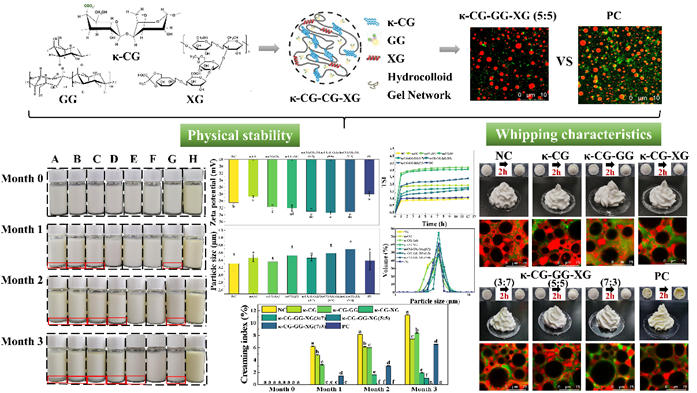
The most impressive performance: ternary κ-CGG-XG mixture with a GG:XG ratio of 5:5 exhibited the best performance in all indicators.
- Foam Hardness — Achieved 1418.09 ± 48.14 g (significantly higher, p < 0.05) compared to κ-CG—GG (890.57 ± 68.41 g) and κ-CG—XG (1093.16 ± 31.21 g).
- Elasticity & Recovery - The highest elastic modulus (G' ) and the best shear-recovery properties allowing to maintain shape and withstand mechanical stress in processing and piping.
- Microstructure - Confocal microscopy revealed a very strong, foam network with even distribution of air cells, much stronger than binary or single-polysaccharide networks.
- Stability - No foam deterioration after 2 hours and no discernible syneresis after 3 months, eliminating significant quality flaws in commercial whipped cream.
kappa-CG itself enhanced the acceleration of whipping but provided bad stability in the long-term. Binary blends enhanced certain properties (e.g., κ-CG -GG enhanced yield stress but exhibited poor thixotropic recovery; κ-CG -XG enhanced strong shear-thinning but poor structural recovery). The triadic system was the only one that incorporated the most desirable features.
Mechanisms Behind the Synergy
The increased activity is due to complementary interactions between the polysaccharides:
- Xanthan Gum (XG) - Xanthan Gum offers steric stabilization and electrostatic repulsion, inhibiting coalescence and creaming of droplets.
- κ-Carrageenan (κ-CG) and Guar Gum (GG) - A gel made of hydrogen bonds capable of entraping air bubbles and water.
- Space-Filling Effect of Guar Gum — Fills interstitial spaces within the network, forming a strengthened three-dimensional structure that is not easily drained or collapsed.
The multi-level synergy leads to a stabilized emulsion-foam hybrid that is suitable in high-quality whipped toppings, aerosol cans, and plant-based options.
Food Technology and Dairy Processing implications
In the case of the food industry, the findings provide new avenues:
- Product Development — Develop whipped creams with long shelf life, less syneresis and high end texture, no synthetic additives.
- Clean-Label Appeal - Natural hydrocolloids are consistent with consumer trends of minimal-ingredient, stable dairy products.
- Processing Efficiency -Enhanced shear-recovery and elasticity facilitates industrial whipping, piping, and packaging.
- Sustainability - Optimization of polysaccharide blends can be used to reduce the use rate whilst achieving the same performance level, which saves on costs and contaminating the environment.
The work fills gaps in trends in emulsion science, functional hydrocolloids, and clean-label stabilization strategies observed in ice cream, sauces, and non-dairy alternatives.
Summary: Next-Generation Whipped Cream, a Blueprint
The 3-way xanthan gum-guar gum-κ-carrageenan system (preferred GG:XG = 5:5) proves to be the best stabilizer, with commercial grade foam hardness, elasticity, microstructure, and long-term stability. Using synergistic interactions, food manufacturers will be able to overcome the traditional constraints and develop whipped cream products that are of high-quality, can be processed, and have better shelf performance.
Article in Original: ScienceDirect - Synergistic effects of κ-Carrageenan polysaccharide blends.
Full Citation: Cui, G., et al. (2026). The effects of κ-Carrageenan-Polysaccharide blends on the microstructure and rheology of whipped cream are synergistic. Food Hydrocolloids, 175, 112505.
Keywords: stability of whipped cream, κ-carrageenan mixtures, xanthan gum and guar gum synergy, food hydrocolloid, microstructure of food emulsions, rheology of dairy products, syneresis inhibition, polysaccharide stabilizers, whipped cream shelf life.