
By FoodTechX Editorial Team
Published: September 9, 2026 | Read Time: 9 Minutes
A new study published in Exploration introduces a bioinspired approach to fresh-produce preservation: a sprayable, biodegradable protective wrap modeled on the natural calyx of Physalis peruviana. The material combines polycaprolactone, chitosan and zeolite to provide antimicrobial protection, high breathability, ethylene adsorption and biodegradability, while extending the reported shelf life of several fruits by more than seven days under the study's experimental conditions.
For food processors, produce packers, exporters and packaging technology developers, the research is particularly interesting because it brings together several challenges that are normally treated separately: freshness preservation, food loss reduction, active packaging, biodegradable materials and sustainable food processing.
The research, titled “A High-Efficiency Yet Sustainable Fresh-Keeping Strategy Inspired by Calyx of Physalis peruviana,” was published online in Exploration on July 29, 2026, with DOI 10.1002/EXP.20250786.
Rather than simply creating another biodegradable plastic film, the researchers developed a protective fibrous network that can be deposited directly onto fruit surfaces using a portable handheld electrospraying system.
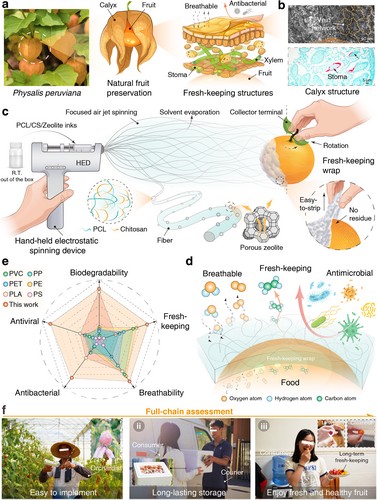
The result is an interesting example of how principles found in nature can be translated into advanced materials and, potentially, into new approaches to post-harvest food processing.
Why Fresh-Produce Packaging Remains a Difficult Engineering Challenge
Fresh fruits and vegetables continue to respire and undergo biochemical changes after harvesting. During storage and transportation, moisture loss, microbial contamination, oxidation and ripening can progressively reduce quality.
Packaging therefore needs to perform several functions at the same time.
It should help protect the produce from external contamination and physical damage, while controlling moisture and gas exchange. For climacteric fruits, controlling ethylene can also be important because ethylene plays a major role in ripening.
At the same time, conventional petroleum-based packaging materials such as polyethylene and polypropylene can create significant waste-management and environmental challenges because they are designed for durability and can persist in the environment for long periods.
Biodegradable alternatives have attracted considerable attention, but replacing conventional packaging is not simply a matter of finding a material that decomposes more quickly.
A practical food-packaging material also needs to provide sufficient mechanical and barrier performance, maintain an appropriate microenvironment around the food, support food safety, and work with real processing and distribution conditions.
This creates a fundamental engineering challenge:
How can packaging protect food effectively without creating a long-lived environmental burden?
The researchers behind the new study approached this question from an unusual direction—by looking at how nature already protects fruit.
Learning From Nature: The Protective Calyx of Physalis peruviana
The inspiration for the research came from the calyx of Physalis peruviana, commonly known as Cape gooseberry or goldenberry.
The calyx naturally forms a protective enclosure around the developing fruit. Its structure provides physical protection while allowing interactions between the fruit and its surrounding environment.
Instead of copying the calyx simply as a visual model, the researchers investigated its structure–function relationship.
The natural structure combines protective characteristics with pathways that allow gas exchange. This provided a biological model for designing a synthetic material capable of protecting fruit while maintaining sufficient permeability.
This approach is known as biomimetic or bioinspired engineering.
Rather than asking how to make a conventional plastic film slightly more sustainable, the researchers effectively asked a different question:
Can the functional principles of a natural protective structure be recreated using engineered materials?
The resulting system is called the PCZ wrap, based on its three principal components:
-
Polycaprolactone (PCL) — a biodegradable polyester used as the structural polymer;
-
Chitosan (CS) — a biopolymer known for film-forming and antimicrobial properties;
-
Zeolite — a porous mineral incorporated partly for its ability to adsorb ethylene.
Together, these materials form a multi-scale fibrous network intended to provide several preservation functions within a single protective layer.
From Handheld Electrospraying to a Protective Fruit Coating
One of the most distinctive aspects of the research is the application method.
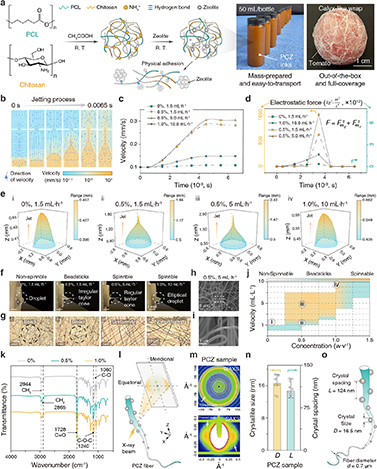
Instead of first manufacturing a conventional sheet of packaging material and then wrapping the fruit, the researchers used a handheld electro-jetting device (HED) to deposit the material directly onto the fruit surface.
The reported device weighs approximately 350 grams and consumes no more than 50 watts, providing a portable approach to producing the coating.
The precursor formulation contains PCL, chitosan and zeolite. When processed through the electro-jetting system, the material forms a conformal fibrous network over the irregular surface of the fruit.
This is potentially important from a food-processing perspective.
A conventional film has a predefined geometry. It must be manufactured, cut, transported, stored and subsequently formed around the product.
A sprayable or electrosprayed coating takes a different approach: the protective layer is formed directly where it is needed.
For irregularly shaped fresh produce, such a system could eventually offer greater flexibility in how preservation treatments are incorporated into post-harvest operations.
However, the current study should be viewed primarily as a scientific and experimental demonstration. Moving from handheld application to high-throughput commercial processing would require additional engineering work involving throughput, coating uniformity, automation, drying, process control and food-contact compliance.
How the PCZ Wrap Works
The researchers designed the PCZ system around several complementary functions.
1. A Breathable Multi-Scale Network
Fresh produce needs to exchange gases with its environment.
A completely impermeable package can create an unfavorable internal atmosphere, potentially accelerating deterioration under some conditions.
The fibrous structure developed in this research provides interconnected pathways for gas and moisture exchange.
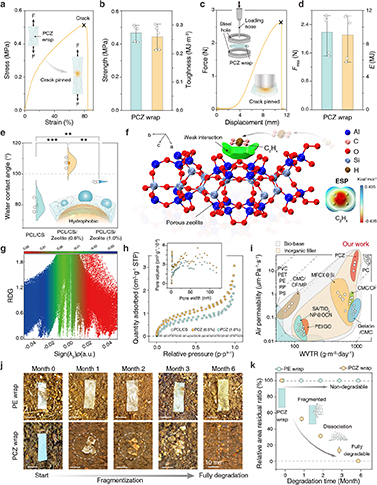
The researchers reported a water-vapor transmission rate of approximately 1,500 g·m⁻²·day⁻¹, demonstrating the high permeability of the structure under the tested conditions.
This breathability is particularly important because the objective is not simply to seal the fruit away from its environment.
Instead, the material is intended to create a controlled microenvironment around the produce.
2. Chitosan-Based Antimicrobial Protection
Chitosan contributes another important function.
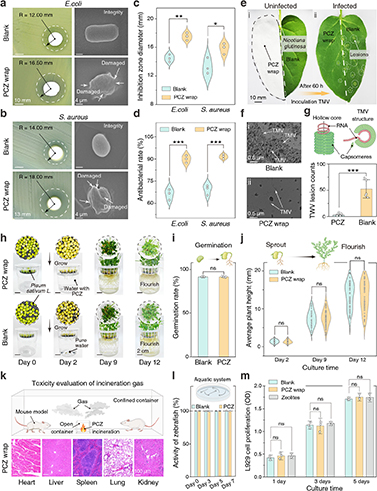
The researchers found that the PCZ wrap exhibited significant antibacterial activity against the tested bacterial strains, including Escherichia coli and Staphylococcus aureus.
The study reported antibacterial efficacy of more than 92% under the experimental conditions.
This suggests that the coating can function as more than a passive physical barrier.
Instead, it may contribute directly to controlling microbial contamination at the surface of the produce.
3. Zeolite for Ethylene Adsorption
Ethylene is particularly important for climacteric fruits such as tomatoes, bananas and mangoes.
These fruits continue to ripen after harvest, and ethylene acts as an important signaling molecule in this process.
The researchers incorporated zeolite into the PCZ system because of its porous structure and ethylene-adsorption capability.
The concept is straightforward: rather than allowing ethylene to accumulate around the fruit, the material provides adsorption sites that can help regulate the local ethylene environment.
This is one of the reasons why the research is particularly relevant to active and intelligent food-packaging research.
4. Conformal Surface Protection
Because the material is deposited directly onto the fruit, the resulting network can conform to irregular surfaces.
The researchers designed the structure to be thin and flexible, allowing it to provide protection without forming the rigid geometry associated with traditional packaging materials.
Reported Antibacterial and Antiviral Performance
The biological performance of the PCZ wrap was evaluated using laboratory tests.
The researchers reported more than 92% antibacterial efficacy against the tested bacterial strains, including E. coli and S. aureus.
The material was also evaluated against tobacco mosaic virus (TMV) as a model RNA virus. The study reported more than 95% inhibition in the antiviral evaluation.
These results demonstrate the potential of the material as an active protective layer rather than simply a passive packaging film.
However, it is important to distinguish laboratory antimicrobial testing from commercial food-safety claims.
The reported results apply to the organisms, test methods and experimental conditions used in the study. Commercial deployment for specific food products would require appropriate validation, regulatory assessment and food-contact safety evaluation in the intended market.
For food manufacturers, this distinction is important.
A promising material can be scientifically interesting while still requiring substantial validation before it can be incorporated into a regulated commercial food-processing operation.
Fresh-Keeping Tests on Cherries, Tomatoes, Bananas and Mangoes
The researchers did not limit their evaluation to material characterization.
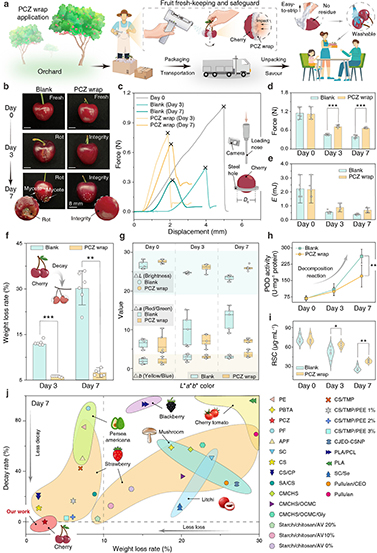
The PCZ wrap was also tested on several types of fruit, including cherries, tomatoes, bananas and mangoes.
These fruits represent different post-harvest behaviors. Cherries are non-climacteric, while tomatoes, bananas and mangoes are climacteric fruits whose ripening is strongly associated with ethylene activity.
The experiments were conducted at approximately 25 ± 2°C and 50% relative humidity.
Under the reported experimental conditions, the PCZ-treated fruits maintained better quality characteristics than untreated controls and showed improved preservation performance.
The researchers evaluated indicators including:
-
weight loss;
-
color stability;
-
firmness;
-
peroxidase activity;
-
reducing sugar content;
-
visible deterioration and mold development.
One reported comparison showed that the untreated control group reached approximately 31.1% weight loss at the relevant observation point, while the PCZ-treated group showed approximately 8% weight loss.
The researchers also reported that the treatment extended fruit shelf life by more than seven days without apparent quality loss under the experimental conditions.
These findings are particularly relevant to long-distance produce distribution.
For exporters, distributors and retailers, additional usable shelf life can provide more flexibility during transportation, warehousing and sales.
Even a relatively small improvement in post-harvest stability can potentially reduce the amount of produce that reaches the end of its commercial life before it can be sold.
The actual economic benefit, however, would depend on the specific fruit, supply chain, storage conditions, treatment cost and commercial operating model.
Biodegradability: Addressing the End-of-Life Problem
Performance during use is only one part of sustainable packaging.
What happens to a material after the food has been consumed is equally important.
The PCZ system was designed using biodegradable components, and the researchers evaluated its degradation behavior in soil.
The study reported approximately 57% degradation after one month and complete degradation within 180 days under the tested conditions.
This is significantly different from conventional petroleum-based plastic wraps, which can remain in the environment for much longer periods.
For sustainable packaging development, this creates an important advantage: the material is designed not only to preserve food during its useful life, but also to break down after disposal.
Nevertheless, biodegradability should always be interpreted according to the environmental conditions used in testing.
Actual degradation rates can vary depending on temperature, humidity, soil composition, microbial activity and other environmental factors.
For commercial packaging systems, end-of-life performance therefore needs to be evaluated according to the disposal environment and regulatory requirements of the target market.
Life-Cycle Assessment Reports an 84.97% CO₂ Reduction
Perhaps one of the most notable findings is the study's life-cycle assessment.
Biodegradability alone does not automatically mean that a packaging system has a lower overall environmental footprint.
Manufacturing energy, raw materials, transportation, processing and end-of-life treatment all contribute to environmental impact.
The researchers therefore conducted a life-cycle assessment comparing the PCZ system with conventional packaging materials.
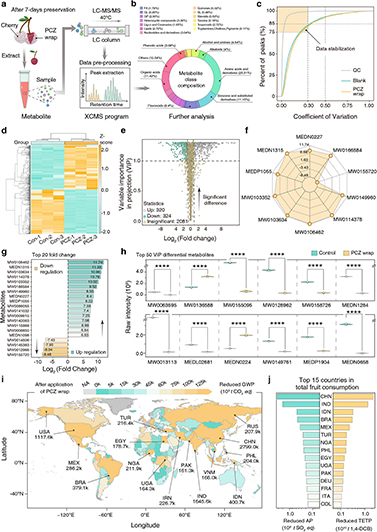
Under the study's defined assessment framework, the PCZ wrap was reported to reduce global warming potential by 84.97%, expressed in terms of CO₂ emissions, compared with conventional plastic wraps.
This result suggests that the environmental benefits of the proposed technology may extend beyond the reduction of persistent plastic waste.
At the same time, LCA results depend on system boundaries, assumptions, functional units and input data.
Commercial-scale implementation could therefore produce different results depending on where the raw materials are manufactured, how much material is applied to each kilogram of produce, the energy source used by the coating equipment, transportation requirements and end-of-life conditions.
For food manufacturers evaluating sustainable packaging, these variables should be considered before making direct environmental comparisons.
What This Research Could Mean for Food Manufacturers
The significance of this study extends beyond the material itself.
If sprayable active packaging technologies eventually move toward commercial production, they could influence how post-harvest processing lines are designed.
A conventional fresh-produce line may include processes such as:
harvesting → washing → sorting → grading → drying → packaging → cold storage → transportation
A future coating-based preservation system could potentially introduce an additional step:
harvesting → washing → sorting → grading → drying → coating → controlled drying → inspection → packaging
The exact configuration would depend on the produce, coating formulation, required application rate and regulatory requirements.
This means that the adoption of new packaging materials can become an engineering and process-integration challenge, not simply a material purchasing decision.
Food manufacturers may need to evaluate:
-
coating uniformity;
-
application speed;
-
product handling;
-
drying time;
-
nozzle configuration;
-
material consumption;
-
integration with conveyors;
-
compatibility with washing and drying systems;
-
quality inspection;
-
worker safety;
-
food-contact compliance;
-
cleaning and sanitation procedures;
-
maintenance requirements.
These considerations become particularly important when moving from laboratory experiments to commercial production.
From Handheld Application to Industrial Processing
The handheld electrospraying system demonstrated in the study is an important proof of concept.
However, commercial food factories operate at significantly higher throughput.
A future industrial implementation could potentially require automated electrospraying or other controlled coating technologies integrated into existing processing lines.
Such a system would need to maintain consistent coating thickness while handling products at production speed.
Integration could involve several stages.
Surface Preparation
Fruit surfaces may need to be appropriately washed and dried before coating.
The condition of the surface can influence adhesion and coating uniformity.
Controlled Application
Automated spray heads or electro-jetting systems could potentially replace manual application for high-throughput production.
The system would need to control factors such as flow rate, spray distance, voltage, coverage and material consumption.
Drying and Stabilization
After application, the coating may require controlled drying or stabilization before the fruit proceeds to packing.
The required process would depend on the formulation and target product.
Quality Inspection
Machine vision and other inspection technologies could potentially be used to monitor coating uniformity and fruit condition.
Packaging and Cold-Chain Integration
The coating process would ultimately need to work alongside existing packaging, storage and refrigerated transportation systems.
This is where the research opens a broader question for the food-processing industry:
How can advanced preservation materials become part of an integrated production line rather than remain a laboratory technology?
That question will require collaboration between material scientists, food technologists, equipment manufacturers, packaging engineers and food producers.
Potential Applications Across the Fresh-Produce Supply Chain
The research focused on several fruits, but the underlying concept could be relevant to broader post-harvest applications.
Potential areas for future investigation include:
-
fresh fruit exporters;
-
vegetable packing operations;
-
high-value produce;
-
long-distance agricultural transportation;
-
post-harvest treatment;
-
sustainable food packaging;
-
active packaging systems;
-
cold-chain optimization;
-
food-loss reduction.
However, applicability should not be assumed simply because the material worked on several tested fruits.
Different produce varieties have different surface structures, respiration rates, moisture characteristics and ethylene responses.
Future studies would therefore need to determine how coating formulation and application parameters should be optimized for each product category.
The technology may ultimately prove most useful as a product-specific preservation system, rather than a universal replacement for all food packaging.
The FoodTechX Perspective: From Research to Industrial Application
For FoodTechX, the most interesting aspect of this research is the connection between advanced materials science and practical food-processing engineering.
A new sustainable packaging material can create opportunities, but turning it into a commercial process requires more than the material itself.
Food manufacturers may need to source or develop compatible coating equipment, modify existing processing stages, evaluate suppliers, validate food-contact requirements and determine how the new process fits into their production capacity.
As an engineering-driven B2B platform and project service provider, FoodTechX connects food manufacturers with equipment suppliers, technology providers and manufacturing partners for food-processing and packaging projects.
For companies exploring emerging technologies such as active packaging, biodegradable coatings, post-harvest preservation or advanced food-processing systems, the key challenge is often not finding a single machine.
It is determining how the technology fits into the complete production process.
That may include equipment selection, line compatibility, technical specifications, supplier coordination and project-level integration.
The PCZ research provides a useful example of why this broader engineering perspective matters.
The laboratory technology is one component.
The eventual commercial system would need to connect that technology with the realities of food production.
From Biomimicry to the Next Generation of Food Packaging
The PCZ wrap is significant because it demonstrates a broader direction in food technology.
Nature often solves complex problems through structures that perform several functions simultaneously.
The calyx of Physalis peruviana protects the fruit while maintaining a controlled relationship with the surrounding environment.
The researchers translated this principle into an engineered material combining:
biodegradable polymer + antimicrobial biopolymer + ethylene-adsorbing mineral + porous fibrous structure.
The result is a packaging concept that attempts to address preservation and sustainability at the same time.
This approach may represent an important direction for future food packaging research.
Instead of thinking about packaging only as a container, food engineers can increasingly consider packaging as a functional part of the preservation system.
That could lead to new combinations of:
-
active coatings;
-
antimicrobial materials;
-
gas-management technologies;
-
ethylene control;
-
biodegradable polymers;
-
sensors;
-
machine vision;
-
automated coating equipment;
-
cold-chain optimization.
The convergence of these technologies could eventually create more intelligent and resource-efficient post-harvest systems.
What Still Needs to Be Proven
Despite the promising results, the research should not be interpreted as evidence that sprayable PCZ packaging is already ready to replace conventional commercial packaging across the food industry.
Several questions remain.
First, industrial-scale throughput needs to be demonstrated.
Second, coating consistency needs to be evaluated across different fruit sizes, shapes and surface conditions.
Third, commercial food-contact safety and regulatory requirements must be addressed for specific applications and markets.
Fourth, manufacturers would need to understand the complete economics of the process, including material consumption, equipment investment, energy use, labor and maintenance.
Finally, the technology needs to be tested under realistic commercial supply-chain conditions, including refrigerated transportation, storage, handling and retail environments.
These are not weaknesses unique to this research.
They are normal steps in the transition from scientific discovery to industrial food technology.
A successful commercial solution will ultimately need to demonstrate not only scientific performance, but also safety, repeatability, scalability, economics and compatibility with existing food-production systems.
Conclusion
The new research published in Exploration demonstrates an intriguing approach to sustainable fresh-produce preservation.
Inspired by the natural calyx of Physalis peruviana, researchers developed a polycaprolactone/chitosan/zeolite fibrous network that can be deposited directly onto fruit using a handheld electro-jetting system.
Under the reported experimental conditions, the PCZ wrap demonstrated more than 92% antibacterial efficacy, more than 95% inhibition of tobacco mosaic virus, a water-vapor transmission rate of approximately 1,500 g·m⁻²·day⁻¹, more than seven days of additional shelf life, and complete degradation within 180 days. The study's life-cycle assessment also reported an 84.97% reduction in global warming potential compared with conventional plastic wraps.
For the food industry, the most important takeaway may not be that conventional plastic packaging is about to disappear.
Rather, the research demonstrates how biomimicry, advanced materials and food-processing engineering can converge to create new preservation strategies.
The next step is commercialization: determining how such materials can be manufactured consistently, applied efficiently, integrated into production lines, validated for food-contact use and economically deployed across real supply chains.
As food manufacturers face simultaneous pressure to reduce food loss, improve product quality and lower packaging waste, technologies that address several of these challenges at once will continue to attract attention.
The path from nature-inspired research to a modern food factory will require collaboration across materials science, food technology, packaging, automation and engineering.
That is where the future of sustainable food technology may become especially interesting: not simply developing better materials, but designing complete systems that use those materials more effectively.
Research Reference
Zhao, Y., Lu, C., Bai, X., Wu, S., Wang, Z., Hu, Y., Liang, B., Sun, D., Zhang, Y., He, Y., Yang, Y., Duan, S., Sun, T., Wang, X., Lan, W., Zhang, H., Luo, Y., & Liang, X. (2026).
A High-Efficiency Yet Sustainable Fresh-Keeping Strategy Inspired by Calyx of Physalis peruviana.
Exploration. DOI: 10.1002/EXP.20250786
Published online: July 29, 2026.
Original research: Wiley Online Library, Exploration.
FoodTechX News summarizes and analyzes published scientific research for food technology and industrial audiences. The commercial applicability, food-contact safety, regulatory status and performance of emerging technologies should be independently evaluated for specific products, markets and processing conditions.