
Juicy red strawberries and sweet, soft bananas are always tempting to buy more.
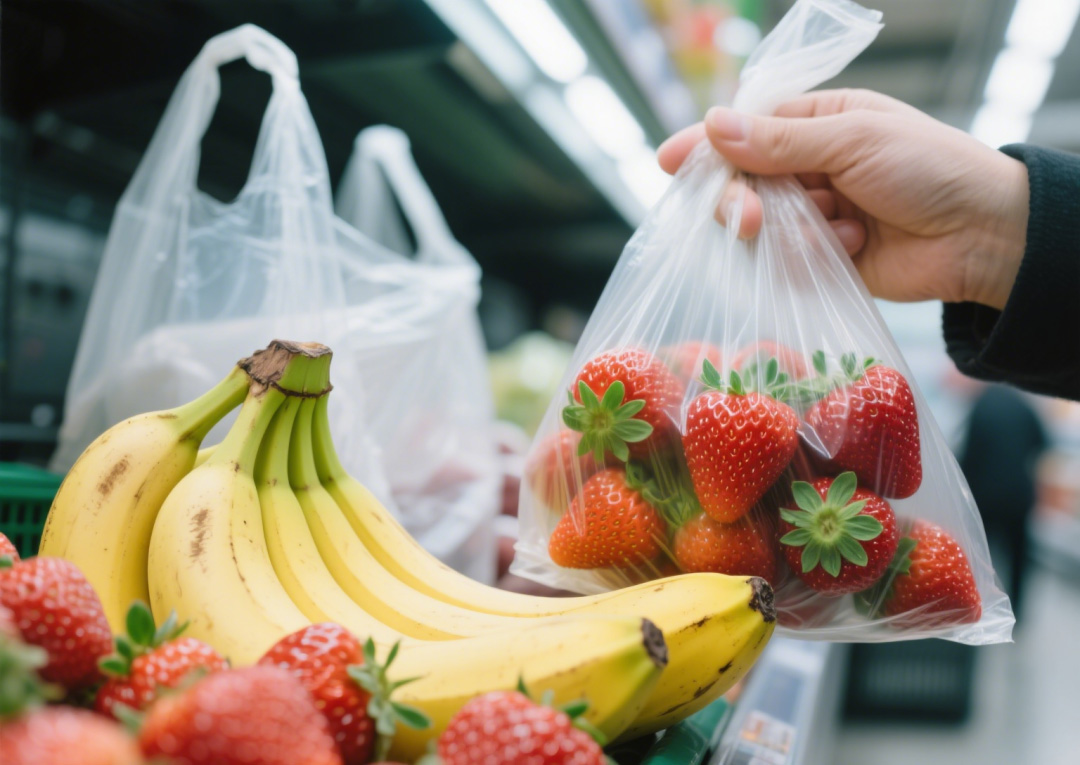
But the next day, you will see the strawberries beginning to seep and mold, and banana peels with black spots. Statistics show that about 1.3 billion tons of food are wasted worldwide every year, of which 500 million tons are fruits and vegetables, causing huge economic losses and resource consumption. So, the prolongation of fresh fruit and vegetable shelf life has become a pressing problem.

Now, various technologies are applied to keep fruit and vegetables fresh, such as wax coating, low-temperature refrigeration, gas packaging, plastic packaging films, and biomass-based preservative coating. However, these technologies are afflicted with poor antimicrobial activity, serious environmental pollution, high energy consumption, and health risks. For instance, the wax coating on the fruit surface brings inconvenience to washing and may influence the taste and even cause potential health risks. Low-temperature refrigeration and gas packaging bring high operating costs and high energy consumption. Commercial plastic packaging films lack antimicrobial and antioxidant activities, leading to poor preservation. In addition, microplastic particles generated from the degradation of plastic packaging can penetrate into the ecosystem and lead to long-term and serious damage.
Scientists are continuously seeking safer and more environmentally friendly alternatives. Recently, the Tea Quality and Risk Assessment Innovation Team at the Tea Research Institute of the Chinese Academy of Agricultural Sciences achieved a breakthrough in tea. Their article, titled "Tea Polyphenol Self-assembly Nanocomposite Coating for Fruit Preservation," was published in the SCI-1 journal ACS Nano.
Tea polyphenols are plant secondary metabolites that are widely distributed in tea, fruits, and vegetables. They possess active hydroxyl groups, rich structures, and high reactivity, naturally conferring antioxidant and antimicrobial properties. Nevertheless, the structure of polyphenols is unstable, so they are readily influenced by environmental factors (e.g., pH, ultraviolet light, and oxygen), which limits their preservation efficiency.
To address those issues, the researchers innovatively proposed a self-assembly nanocomposite coating of tea polyphenols and zinc ions (TPZn). The composite can be efficiently coated on the surface of various biological substrates and can be directly applied as a coating on fruit surfaces, exhibiting multiple preservation functions, including antibacterial, antioxidant, moisturizing, and inhibition of antibacterial film formation. The coating is one-step prepared, which is simple and applicable on a large scale.
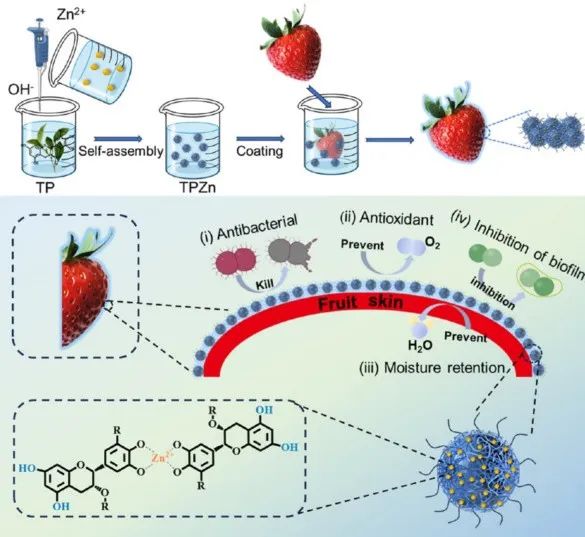
Preparation and Preservation Methods of TPZn Nanocomposite Coatings for Fruit Preservation
This study systematically evaluated the safety and preservation effects of TPZn materials. In toxicology experiments with cells, zebrafish, nematodes, mice, and plant sprouts, revealing good biocompatibility and no evident toxicity. TPZn exhibited remarkable inhibitory activity against typical spoilage bacteria in antibacterial experiments, including Staphylococcus aureus, Pseudomonas aeruginosa, and methicillin-resistant Staphylococcus aureus. Biofilm imaging of bacteria and protein leakage assays revealed that TPZn damaged bacterial cell membranes, suppressing their colonization on the surface of fruits and decelerating the spoilage process at the source.
In fruit field trials, TPZn coating solution was sprayed or soaked on strawberries and bananas, air-dried, and stored at room temperature. Results indicated that TPZn coatings prolonged the shelf life of strawberries and bananas to 6 and 8 days, respectively, more than twice that of the control group. Vitamin C and anthocyanin content were well preserved, weight loss and softening were greatly decreased, and skin browning was greatly postponed, with excellent antioxidant and water-retention capabilities.
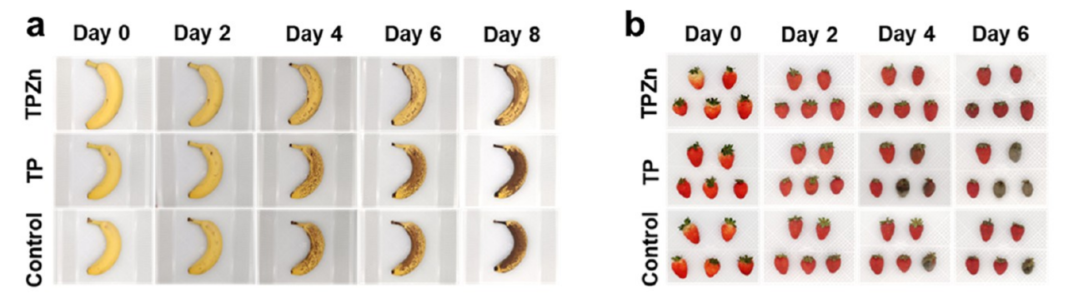
Preservation effects of TPZn nanocomposite coatings on bananas and strawberries were presented in Figure 1. (a) Typical appearance of treated bananas; (b) Typical appearance of treated strawberries.
In addition, in a contamination model experiment, even if strawberries were artificially inoculated with spoilage strains, the TPZn coatings still exhibited excellent antimicrobial performance, effectively postponing spoilage. Moreover, TPZn's preservation effect is comparable to that of commercially used chlorine dioxide preservatives. Moreover, the material itself is natural, safe, and non-irritating, and thus is a promising substitute for conventional preservation techniques.
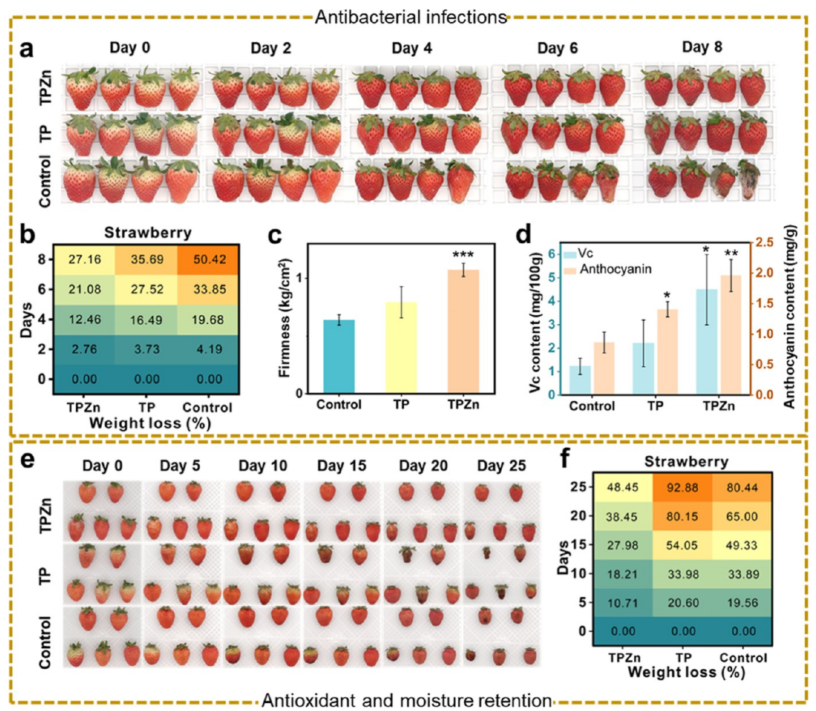
Observational study of antibacterial, antioxidant, and water-retention capabilities of TPZn nanocomposite coatings on the surface of fruit. (a) The changes in the typical appearance of strawberries after different storage times; (b) Weight loss and firmness (c) changes of strawberries after Staphylococcus aureus treatment; (d) The changes in vitamin C and anthocyanin contents in the different treatment groups after 8 days' storage; (e) The condition of strawberries after different storage times in a 4°C refrigerator.
This research offers a novel, natural, green, and functionally complex fruit preservation technique, providing a crucial theoretical and practical foundation for the innovation of a new generation of edible functional coating material. It has great application potential in facilitating loss reduction, conservation, green packaging, and food safety.