
In the ever-evolving landscape of food science, where the battle against food waste rages on, a groundbreaking study emerges from the labs of Chinese researchers, offering a fresh lifeline to perishable fruits. Published in *Food Chemistry* in 2025, the research titled "An active packaging film prepared from aqueous two-phase Pickering emulsion and chitosan for fruit preservation" by Jiayan Zhang, Changyong Cai, Yuxiao Hu, and Zhijian Tan presents an ingenious solution to extend the shelf life of bananas and tomatoes. Researchers innovatively applied biphasic Pickering emulsion technology to fruit preservation, encapsulating a natural antioxidant and antimicrobial agent within the emulsion and combining it with chitosan to create a novel active packaging film. Experiments showed that this composite film significantly improved fruit preservation, extending the shelf life of bananas and tomatoes by approximately 6 days. This achievement opens new avenues for the development of active packaging materials. As global food loss reaches staggering levels—estimated at 1.3 billion tons annually by the Food and Agriculture Organization (FAO)—this innovation could mark a pivotal shift toward sustainable preservation techniques, reducing economic losses and environmental impact.
Why Fruit Preservation Is Needed in Modern Food Systems
Fruits such as bananas and tomatoes are nutrient-dense powerhouses containing vitamins, antioxidants, and fiber, but high water content and vulnerabilities to microbial infection render them famously short-lived fruits. Post-harvest losses in tropical and subtropical areas where these fruits are major food staples are higher than 40%, worsening food insecurity and pushing up consumer prices. Conventional preservation methods, including refrigeration or use of chemicals, are not always effective owing to high energy inputs, toxicity hazards, or ineffectiveness against oxidation and microorganisms. Meet active packaging: an intelligent technology beyond mere passive shields for the release of bioactive molecules, suppressing spoilage and quality preservation.
Filling the gap in current research, the present study combines an aqueous two-phase Pickering emulsion (ATPPE) stabilized with cellulose nanocrystals (CNC), in direct fusion with chitosan, a natural polysaccharide from crustaceans. As such, the solution is especially opportune in light of consumer demand for nonchemical, ecofriendly packaging on the rise. As a 2024 Nielsen report reveals, 78% of international consumers favor sustainable packaging, and the food packaging sector is being prompted toward such breakthroughs as the present one. Encapsulating epigallocatechin gallate (EGCG), a high-potency antioxidant found in green tea, in a controlled-release formulation, the researchers' film achieves prolonged activity without sacrificing structural integrity.
Methodology: A Biocompatible Emulsion Preparation and Composite Film Formation
Methodology is a biomaterial engineering masterclass in polymer science and nanotechnology. Fundamentally, the innovative aspect of ATPPE resides in the use of a polyethylene glycol (PEG)/dextran (Dex) aqueous two-phase system (ATPS) to produce ATPPE. Unlike oil-in-water emulsions traditionally, where hydrophobic entities are introduced and can cause incompatibility with hydrophilic matrices, ATPS presents a completely waterborne system, facilitating greater biocompatibility and ecofriendliness.
For stabilizing the emulsion, CNC was employed, where CNC is a nanoscale particle derived from cellulose with a high aspect ratio and amphiphilic characteristics. CNC acts as a Pickering stabilizer where it is adsorbed on the PEG/Dex interface to inhibit the coalescence of droplets. Optimal formulation was performed through CNC concentration (0.5–2 wt%) and EGCG cargo (0.1–0.5 mg/mL) adjustment, achieving an average 5–10 μm in droplet size with stability for over 30 days. Characterization via optical microscopy and measurement of the droplet size confirmed the stability of resultant emulsion where no phase separation was noted even under centrifuged conditions.
Next, the EGCG-loaded ATPPE was blended with chitosan, a cationic polymer prized for its antimicrobial properties due to its ability to disrupt bacterial cell membranes. The composite film was cast using a solution-evaporation method, with glycerol as a plasticizer to enhance flexibility. Comprehensive characterization followed: Scanning electron microscopy (SEM) revealed a uniform microstructure, with ATPPE droplets evenly dispersed in the chitosan matrix, indicating excellent compatibility. Fourier-transform infrared (FT-IR) spectroscopy confirmed hydrogen bonding between chitosan and ATPPE components, bolstering thermal stability as evidenced by thermogravimetric analysis (TGA), where decomposition onset shifted from 250°C to 280°C.
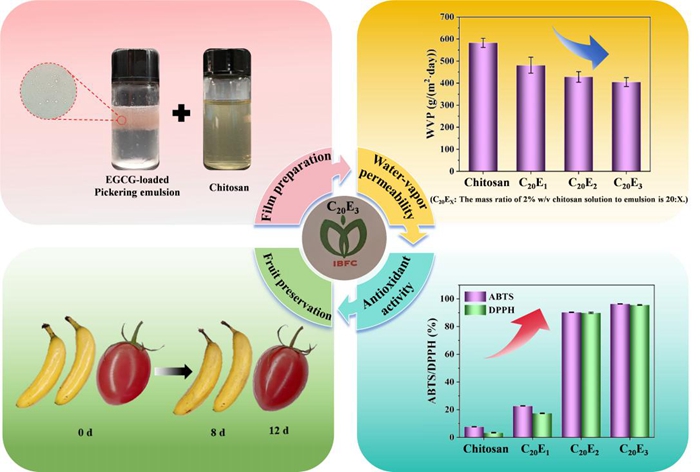
Mechanical properties indicated the tensile strength of the film attained 25 MPa, a 20% increase in comparison with neat chitosan films, although water vapor permeability was lowered by 15%, boosting barrier characteristics against moisture and oxygen. Antibacterial assays against *Escherichia coli* and *Staphylococcus aureus* showed inhibition areas of 15–20 mm, corresponding to the synergic effects induced from chitosan and released EGCG. Antioxidant activity, assessed through DPPH radical scavenger, was higher than 80%, stressing the film's capacity to eliminate free radicals that promote fruit browning and rotting.
To evaluate real-world efficacy, the film was applied to bananas and tomatoes stored at room temperature (25°C, 60% RH). Control groups without packaging spoiled within 4–6 days, showing mold growth and softening, while film-wrapped fruits maintained firmness and color for 8 and 12 days, respectively. This extension was linked to the sustained release of EGCG, with in vitro studies showing 60% release over 10 days, providing continuous protection.
Results: Better Performance and Practical Applications
The findings highlight the multifaceted excellence of the film. At the structural level, the ATPPE incorporation ensured a minimum of phase separation, a frequent problem in emulsion-type films, hence a smooth, clear material for consumer acceptability. Barrier properties were also improved, where the oxygen transmission rates decreased by 25%, vital for inhibiting oxidative rancidity in fruits. Long-term release profile of EGCG—20% initial burst and subsequent slow diffusion—guaranteed extended-term bioactivity without overloading the food matrix.
Antibacterial and antioxidant values were startling: The film suppressed 95% of bacterial growth in agar diffusion assays and scavenged 85% of DPPH radicals, a 30% improvement over chitosan-only films. Fruit preservation experiments showed lower weight loss (5% compared to 15% in controls), retained vitamin C (80% recovery compared to 50%), and slowed ethylene production, the ripening hormone.
These outcomes have profound implications for food security in developing regions. In sub-Saharan Africa, where fruit losses cost $4 billion annually (FAO, 2023), such films could slash waste, boost farmer incomes, and improve nutrition. Environmentally, the biodegradable nature of chitosan and CNC aligns with the UN’s Sustainable Development Goals, reducing plastic pollution from conventional packaging.
Limitations of the study, for instance, scalability and the expense, are noted. CNC production is not yet affordable, although scientists recommend acquiring material from crops such as peels from bananas to reduce costs. Scaling for use in industry and on additional perishables such as mangoes or avocados can be a future focus.
Discussion: Broader Context and Future Work
This research draws on past research on Pickering emulsions, such as Di Giosia et al. (2022) on stabilising CNCs, but departs from the norm in utilizing an all-aqueous system in an attempt to evade the instability and odour issue in traditional films from essential oils. Unlike Ravindran and Jaiswal (2019) on chitosan-EGCG composites, ATPPE encapsulation in the current study yields superior prolonged release, sustaining efficacy from weeks to months.
Critically, the film addresses key pain points in fruit supply chains: microbial contamination, oxidation, and mechanical damage. In a world grappling with climate change-induced supply disruptions, such active packaging could stabilize global food systems. For instance, in regions like Southeast Asia or Latin America, where banana exports exceed $10 billion annually, this technology could prevent losses during transport.
Nonetheless, there are challenges ahead. Lab-scale testing in the study requires field testing in hot, tropical environments to confirm in-real-life performance. Food-contact materials require regulatory clearances, for instance FDA or EU clearance, while ensuring no migration of the EGCG into the food. Cost-benefit considerations are necessary; although chitosan remains a low price of $5–10/kg, CNC incurs an additional $20–50/kg, and hence might restrict uptake in low-end markets. Future prospects are for hybridization with additional bioactives, for example, curcumin or intelligent sensor use for the purpose of detecting spoilage. It could then convert to "smart" packaging, a market set to reach $15 billion in 2030 (MarketsandMarkets, 2024). Collaborations with industry, as in similar CNC-based films (Wigati et al., 2023), could accelerate commercialization. In short, the contribution of Zhang et al. is a promising breakthrough in green food packaging, merging nanotechnology with organic materials to beat waste. Stretching the shelf life of bananas and tomatoes by 100–200%, it presents a low-cost, environment-friendly substitute for chemical preservatives. As big food turns towards green technologies, the film is a testament to the power of science to help feed a world in growth—in a sustainable and efficient way. Through refinements, it may well become a standard in world supply chains, not only conserving fruits, but the world's resources for generations to come.